Two Reasons Why the Housing Market Won’t Crash

Two Reasons Why the Housing Market Won’t Crash
You may have heard chatter recently about the economy and talk about a possible recession. It's no surprise that kind of noise gets some people worried about a housing market crash. Maybe you’re one of them. But here’s the good news – there’s no need to panic. The housing market is not set up for a crash right now.
Real estate journalist Michele Lerner says:
“A housing market crash happens when home values plummet due to a lack of demand for homes or an oversupply.”
With that definition in mind, here are two reasons why this just isn’t on the horizon.
1. Demand for Homes Is Higher than Supply
One of the biggest reasons the housing market crashed back in 2008 was an oversupply of homes. Today, though, it’s a very different story.
It’s a general rule of thumb that a market where supply and demand are balanced has a six-month supply of homes. A higher number means supply outpaces demand, and a lower number means demand outpaces supply. The graph below uses data from NAR to put today’s situation into context:
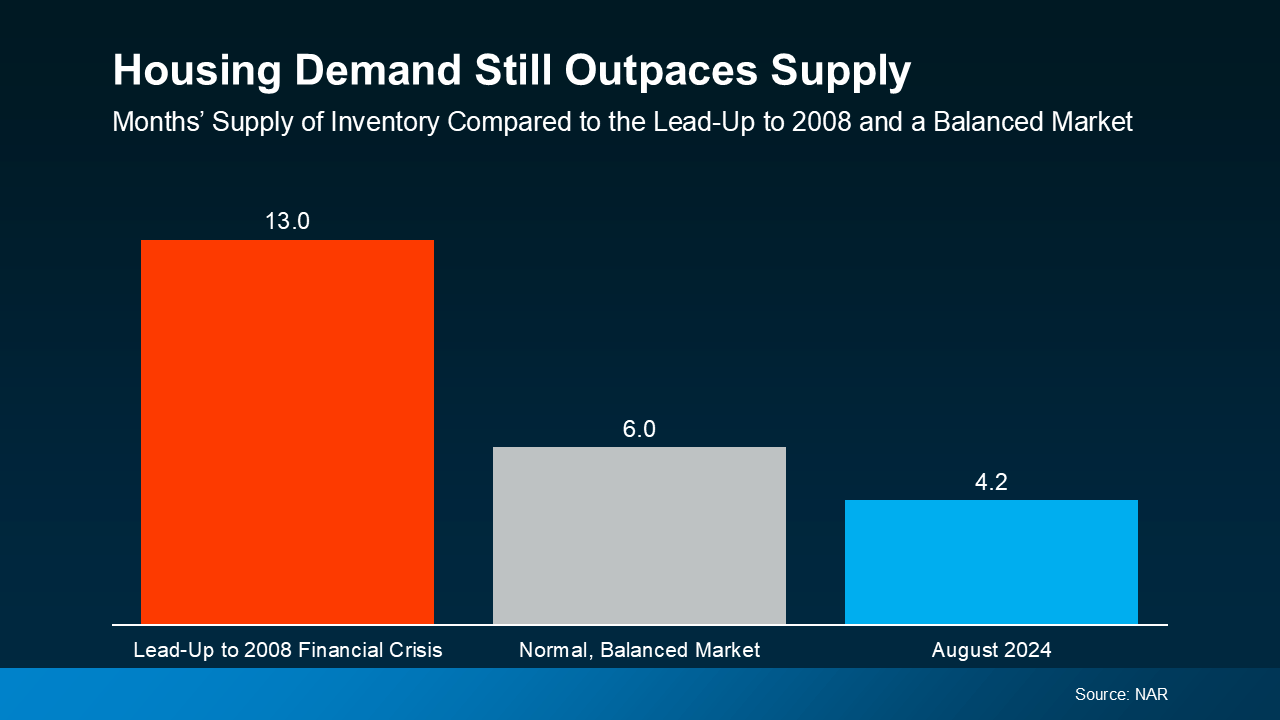 The graph compares housing supply during three different periods of time. The red bar shows there were 13 months of supply before the 2008 crisis, which was far too much. The gray bar shows a balanced market with six months of supply, for context. And the blue bar shows there are only 4.2 months of supply today.
Put simply, there are more people who want to buy homes than there are homes available to buy right now. So, demand is greater than supply. When that happens, home prices stay steady or rise – the opposite of a housing market crash.
It’s important to note that inventory levels differ from market to market. Some areas may be more balanced, while a few could have a slight oversupply, which can impact prices locally. However, most markets continue to experience a shortage of homes.
Lawrence Yun, Chief Economist at the National Association of Realtors (NAR), says:
“We simply don’t have enough inventory. Will some markets see a price decline? Yes. [But] with the supply not being there, the repeat of a 30 percent price decline is highly, highly unlikely.”
2. Unemployment Is Still Low
When people are unemployed, they’re more likely to have trouble making their mortgage payments and may be forced to sell or face foreclosure. That was a big problem during the 2008 financial crisis. Today, the employment situation is much more stable (see graph below):
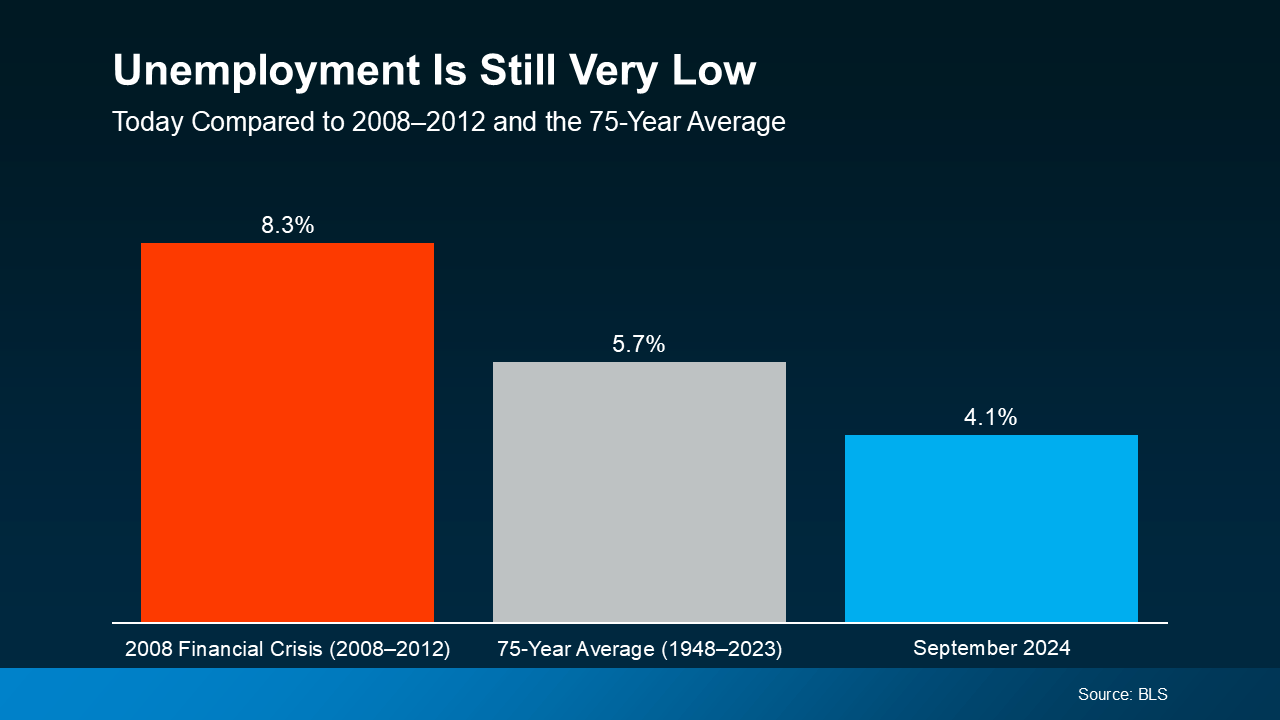 Again, this graph shows three different periods of time, but this one is the unemployment rate. The red bar represents the 2008 financial crisis when unemployment was very high at 8.3%. The gray bar shows the 75-year average of 5.7%. And the blue bar shows the unemployment rate today, and it’s much lower at just 4.1%.
Right now, people are working, earning an income, and making their mortgage payments. That’s one reason why the wave of foreclosures that happened in 2008 isn’t going to happen again this time. Plus, since so many people are employed right now, many are actually in a position to buy a home, and this demand keeps upward pressure on prices.
Today’s Housing Market Is Stronger than in 2008
While it’s understandable to be concerned when you hear talk of a recession and economic uncertainty, but know this: the housing market is in a much better place than it was in 2008. According to Rick Sharga, Founder and CEO at CJ Patrick Company:
“Literally everything is different about today’s housing market dynamics than the conditions that led to the housing crisis.”
Demand for homes still outpaces supply, and unemployment remains low. And these are two key factors that will help prevent the housing market from crashing any time soon.
Bottom Line
The housing market is doing a lot better than it was in 2008, but it’s important to remember that real estate is very local.
So, it’s always a good idea to stay informed about our specific market. If you have any questions or want to discuss how these factors are playing out in our area, feel free to reach out.
Categories
- All Blogs 504
- Buying A Home 74
- Community Neighborhood Guides 18
- DFW Lifestyle 49
- Eat, Drink, & Shop Local 18
- First Time Home Buyer Tips 167
- Homeownership Tips & Tricks 25
- Living in Arlington, TX 13
- Living in Burleson 14
- Living in Dallas Fort Worth Metroplex 83
- Living In Texas 22
- Mansfield, TX 20
- Midlothian, TX 19
- Mortgage Rates, Financing, and Affordability 42
- New Construction & Developments in DFW 15
- Real Estate Investing 38
- Real Estate News 74
- Rentals, Property Management, & Leasing 13
- Selling Your House 167
- Texas Relocation Guide 52
- Things To Do in DFW 12
Recent Posts










MY BLOGS
- Best Local Wineries Near Mansfield, Arlington & South DFW: 8 Spots Worth Visiting When you think about visiting Texas wineries, Fredericksburg and the Texas Hill Country probably come to mind. But did you know we have some wonderful wineries, vineyards, and tasting rooms right here in the Dallas–For
- Townhome vs. Small Single-Family Home: Which Downsizing Option Costs Less in Arlington & Mansfield? When people start talking to me about downsizing, one of the first things they mention is wanting less to maintain. They're tired of mowing a large backyard, cleaning rooms they rarely use, and spendi
- New Master-Planned Communities in DFW: 7 Neighborhoods to Explore in 2026 and Beyond If you've been thinking about buying a new construction home in Dallas–Fort Worth, you've probably noticed just how much development is happening across North Texas. But we're not just talking about new subdivisions
- Which Arlington Neighborhoods Are Zoned for Mansfield ISD? A South Arlington Homebuyer's Guide If you're searching for a home in Arlington, Texas, but you want your children to attend Mansfield ISD, you might be surprised by how many options you have. One of the things I hear from buyers relocating
MY BLOGS
- Best Local Wineries Near Mansfield, Arlington & South DFW: 8 Spots Worth Visiting
- Townhome vs. Small Single-Family Home: Which Downsizing Option Costs Less in Arlington & Mansfield?
- New Master-Planned Communities in DFW: 7 Neighborhoods to Explore in 2026 and Beyond

MY BLOGS
Local News, Events & More Emailed Daily!